


 45 / 76

45
2013 ANNUAL ACTIVITY AND RESPONSIBLE COMMITMENT REPORT
CHALLENGES
Carrefour has a proactive role
in relation to its suppliers,
providing them with the support
they need to improve their own
social responsibility policies.
Since the
“produits libres”
were
first introduced in 1976,
Carrefour has worked with
many companies and SMEs in
order to provide its customers
with high-quality products
manufactured locally. In order
to identify the impacts that their
activities have and implement
a complete sustainable
development policy, Carrefour
has developed, since 2006,
an online self-diagnostic tool
– created with the help of the
ADEME and the WWF – which it
makes available to its suppliers
of own-brand products.
In 2013, nearly 5,300 suppliers
in 11 countries used this tool,
now aligned with the
requirements of the ISO
26000 standard, to measure
the performance of their
CSR policy against 49 criteria.
Examples of best practice
are thus showcased every year
in France at the Carrefour
sustainable development
awards.
Other initiatives have also
been implemented to guarantee
suppliers’ long-lasting growth.
For example, Carrefour has
entered into multi-year
partnerships for its quality
product lines throughout the
world. And in 2013, it set up a
number of training programmes
in China on food quality and
safety with more than
500 farming cooperatives.
Supporting suppliers
Responsible procurement also
means reducing the impact that
one’s logistics operations have
on the environment. In order to
reduce its carbon footprint from
transporting its merchandise,
Carrefour strives to maximise
its delivery vehicles’ fill rate.
In 2013, these optimisation
drives resulted in French
hypermarkets saving the
equivalent of 10,300 tonnes
of CO
2
by having 25,000 fewer
lorries on the roads. The Group
is also developing alternative
forms of transport (rail, river,
etc.) and innovative new
technologies. These include
gradually increasing its
numbers of hybrid and electric
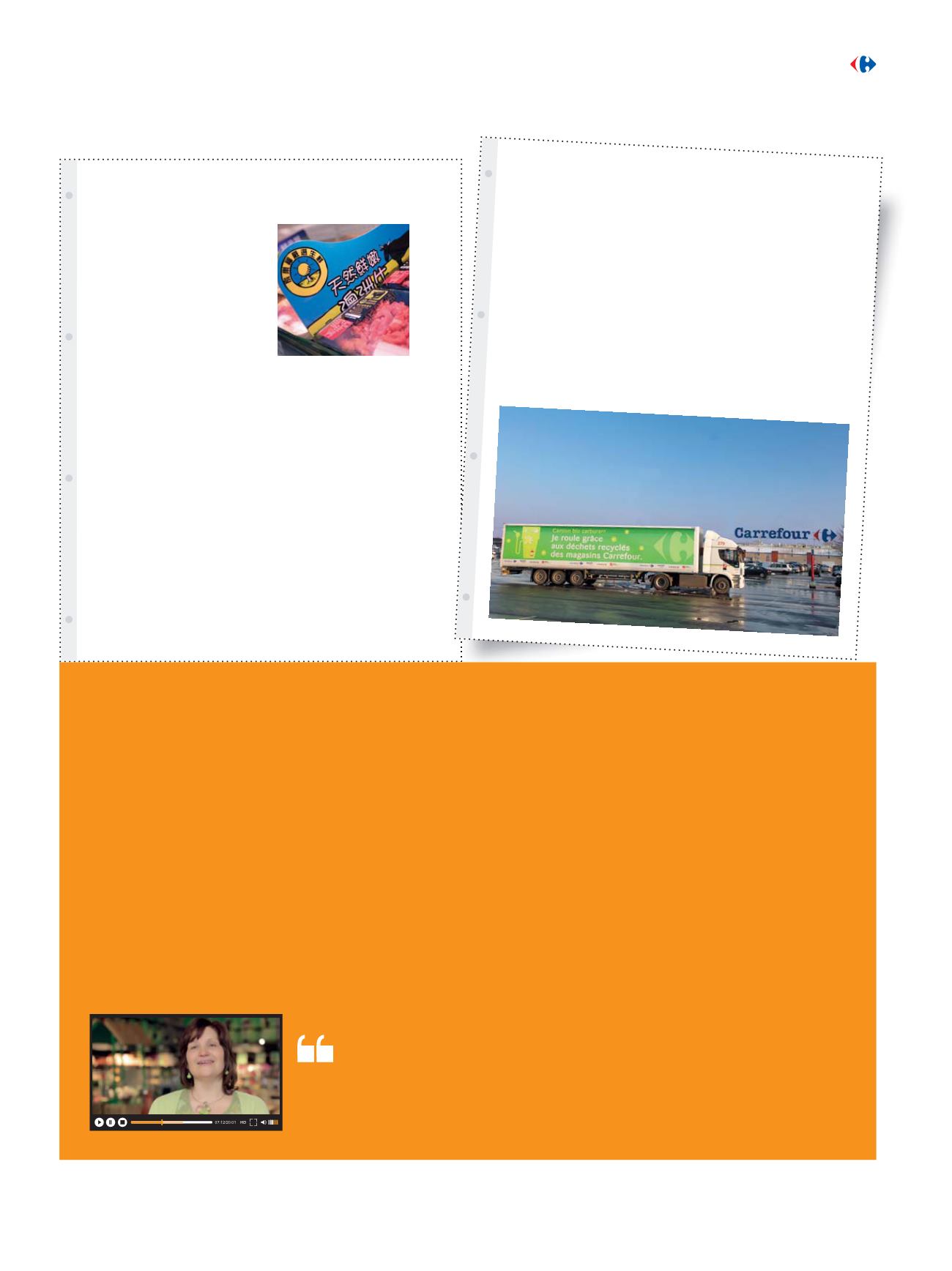
lorries, and testing, in northern
France, lorries which run on
biomethane, a fuel produced by
the methanisation of biowaste
from 14 hypermarkets.
Optimising logistics
PURCHASING LOCALLY – EVERYONE BENEFITS
Throughout the world, the Group’s stores are
widening their selections of local products
and are sourcing their supplies from farmers,
breeders, SMEs and artisans who are based
near to where the customers live. In France,
each Carrefour hypermarket works with around
100 local producers on average. This direct
supply policy generates benefits at all levels.
It provides customers with a wider choice,
as well as better-tasting regional products;
it guarantees product freshness and quality
since there is a direct relationship between
producers and stores. Only a very short time
is spent getting the products from the farm or
factory to the store shelves; low logistics costs
mean lower prices for customers, and local
producers have an outlet for their products,
stimulating the local economy.
Customers are encouraged to purchase locally
especially through the development of regional
brands such as
Reflets de France
and
Terre
d’Italia,
quality product lines which shorten
supply channels. In China, within the framework
of a nationwide programme, Carrefour has
been sourcing products directly from farming
cooperatives, representing more than
1.2 million Chinese farmers, since 2007.
At Group level, nearly 75% of all Carrefour
food products come from national suppliers.
Carrefour employees do not simply buy from
local producers. They help them, providing
themwith the support and training they need.
In Spain, for example, several thousand
products were showcased in 2013 as part of
in-store campaigns, major agricultural shows,
Carrefour award events for innovative SMEs,
and along the route of
La Vuelta
(Tour of Spain
cycling race).
“In the Hainaut region, our stores have entered into partnerships with local artisans
and producers located within around 40 km. Their products are sold in a special dedicated
area. Our customers are delighted to find products from where they live available on the shelves.
And that way, we are boosting the local economy.”
Nathalie Cornard,
in charge of local supplier partnerships for the Hainaut region (Belgium)