


 82 / 104

Reducing foodwaste and
packaging, recoveringwaste,
controlling energy costs,
optimising delivery rounds…
Carrefourmakes every effort
to fight all forms of waste.
Employees implement
this policy in cooperation
with suppliers, customers
andNGOs to develop practical,
effective and sustainable
solutions. Overview.
Carrefour hasdevelopedacomprehensive
plan to fight waste that drives the com-
pany towards a more efficient use
of resources. In addition to actions taken
to optimise the supply chain (see
pages 34-35), employees aim to reduce
the company’s carbon footprint, reduce
water, energy and paper consumption,
use fewer cardboard boxes, raise custo-
mer awareness and encourage innova-
tion in their own business function.
Reducingfoodwaste
Carrefour stores work each day to reduce
breakage and unsold stock. Product by
product, teams ensure that orders and
inventoriesmatchcustomer demand, akey
step in reducing costs and eliminating
waste. In addition, Carrefour relies on a
broad network of food aid organisations,
such as social grocery stores, FoodBanks
andlocalassociations,todistributeproducts
withdrawn from sale – though still per-
fectly edible–topeopleinneed.TheGroup
cooperates closely with its suppliers to
eliminate best-before dates and extend
use-bydatesof certainproductswhenever
possiblewithout affectingquality. Carrefour
supportsandencourages its suppliers, and
annuallyawards thosewhoaremost active
in thefight against foodwaste.
Reducingconsumption
For many years, Carrefour has worked to
reduce the company’s carbon footprint.
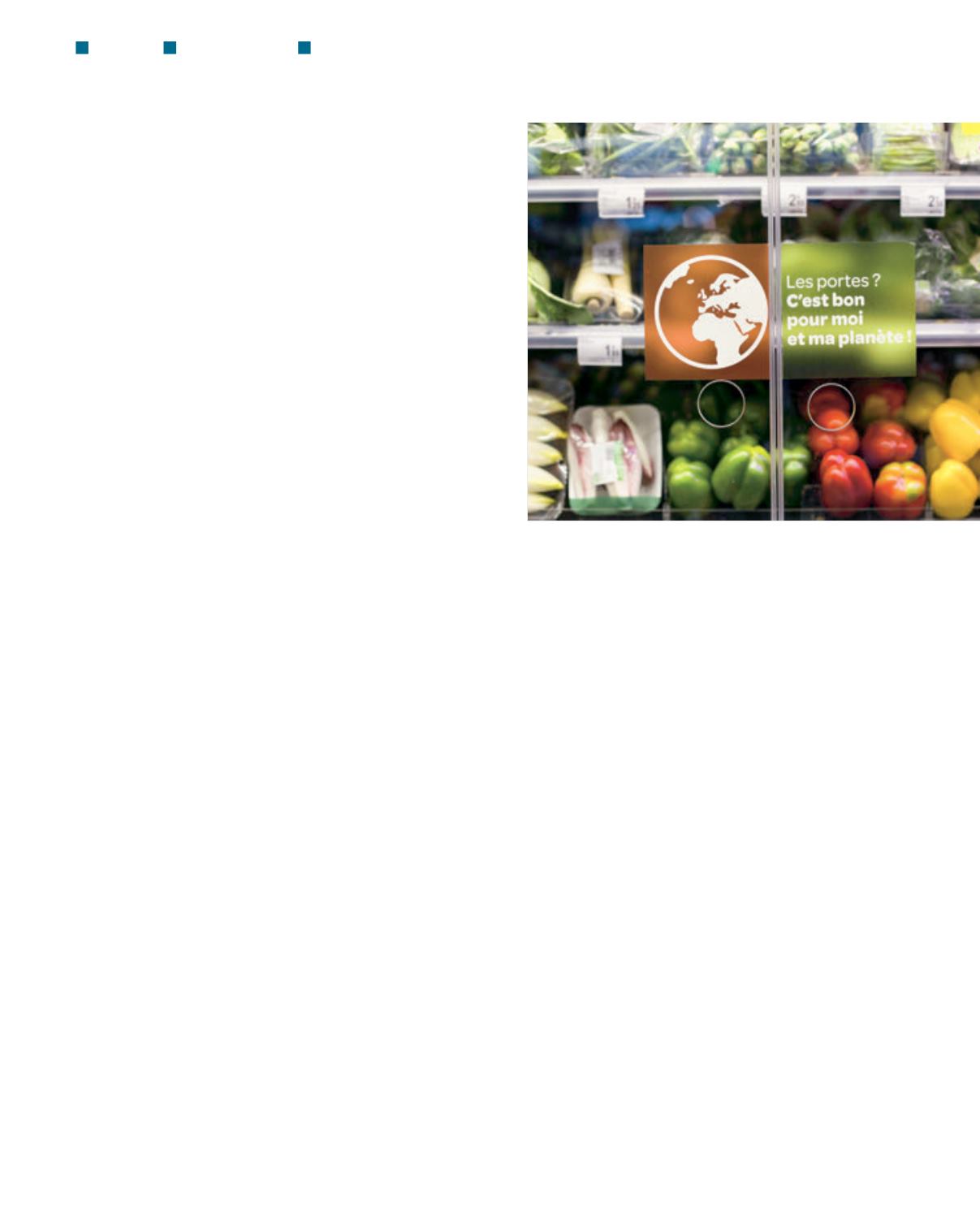
In 10 years, store energy consumption
(1)
has fallen by 31.1%, due to continued
investment in asset renovations such as
closed refrigeration units and energy-
efficient lighting. Carrefour was one of the
first to develop refrigeration units that run
on transcritical CO
2
, which ismoreenergy-
efficient than conventional fluids.
Following the same logic, Carrefour has
also developed innovative solutions to
reducewater consumption, such as recy-
cling rainwater when drinkable water is
not required. From 2012 to 2014, water
consumption in stores fell by 8.9%.
(1) Consumption of electricity, fuel and gas in 2014 vs 2004
per sq. m. of sales area.
COMMIT GET INVOLVED HELP
Work
efficiently
and tackle
waste
82