



 669-Fuel management and Reporting / 748

Fuel Mana
g
e
m
ent and
R
e
p
ortin
g
BOS-PRD-07.901001
Version 04. Original date:25/05/ 2012. Version date: 31/12/2014. Valid version only on QMS site. Uncontrolled document when printed.
Procedure prepared by: BOS Environmental Coordinator. Approved by: BOS QHSES Manager. Validated by: BOS Quality Representative.
5 / 8
4
D
escri
p
tion
4
.1 Fuel
m
ana
g
e
m
ent on
D
iesel
E
lectric
D
riven
V
essels
Low fuel consumption of diesel electric driven vessels represents a key competitive advantage. Therefore,
Masters
are expected to consider this matter with great attention and to comply with the following
requirements.
This procedure has to be considered as our standard of operation and
shall
be included in
Master’s
standing
orders, implementation will be monitored by
C
o
mp
any Mana
g
e
m
ent
and by
Customer’s Logistic
D
e
p
art
m
ents
thr
ough vessel’s reporting.
4
.1.1
T
raditional
p
ro
p
ulsion vs
D
iesel
E
lectric
D
riven
V
essels
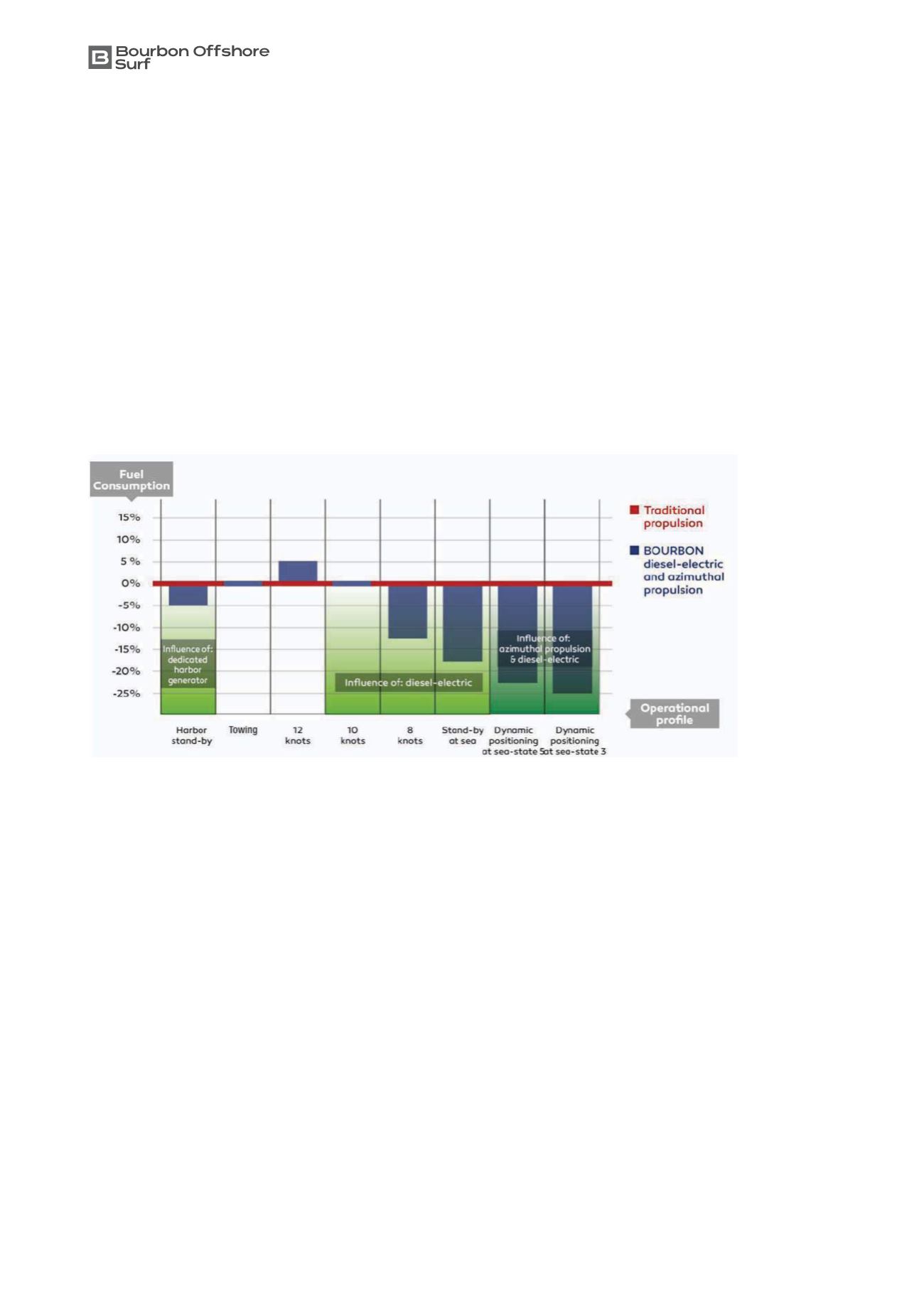
This graph shows a comparison between Traditional and Diesel Electric Driven vessels on efficiency per
operating mode.
Dynamic Positioning Operations represent the biggest saving between the two propulsions.
4
.1.
2
Har
b
our
S
tand
b
y
x
If vessel is equipped with an Emergency/Harbour Diesel Generator:
The harbour generator
shall
be preferred in any case for harbour, standby buoy or anchored station.
Use of other Diesel Generator (DG) may be tolerated when Harbour DG is unavailable or when
power demand is exceeding the power of Emergency/Harbour Generator . If Emergency/Harbour
Diesel Generator is unavailable, this degraded situation
shall
be immediately reported to the
O
p
erations Mana
g
er
.
4
.1.
3
T
ransit
Before any transit the
Master
shall
estimate the best economical speed taking at least into account
the vessel deadweight, the trim and the weather forecast and the possibility to transit on one engine
only;
This economical speed
shall
be proposed to client onshore logistic or to
O
ff
shore
I
nstallation
Mana
g
er
/Installation Radio room depending of the transit type (to port/interfiled/to field);
Economic Speed (up to 9 knots), i.e. with one DG, is expected for all transit unless the
Master
receives a different instruction from the client,
C
ontracts Mana
g
er
or
O
p
erations Mana
g
er
;
669