


 596/ Anchor Handling and Towing Operations Procedure / 992

A
nc
h
or
H
andlin
g
and To
w
in
g
O
p
erations
P
rocedure
BOS-
P
RD-2
6
.900
6
14
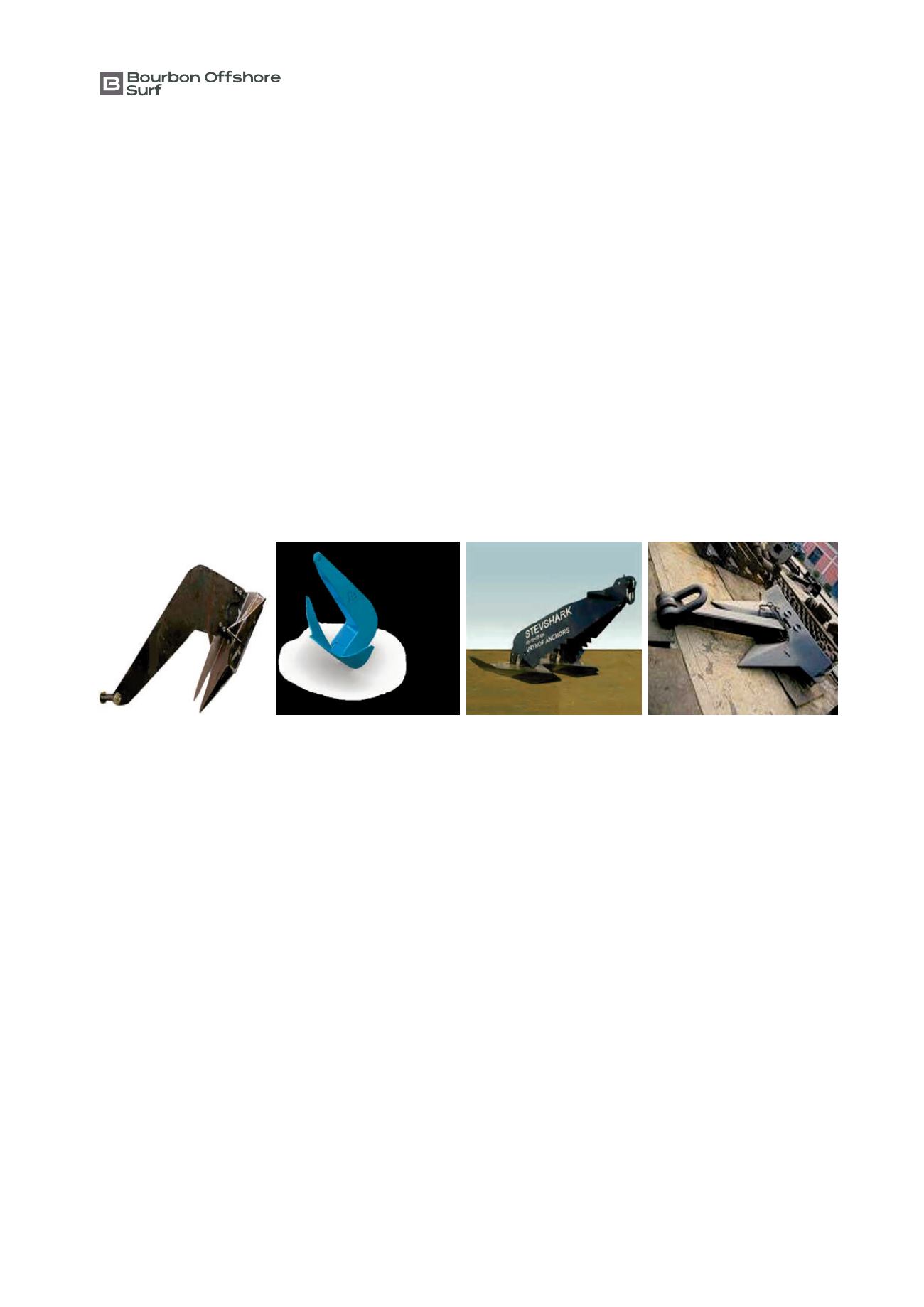
4.2.1.4 Anchors
Most
sem
i-
submers
i
b
l
e
dr
illi
ng
r
i
gs
today
use
S
tevpr
i
s
anchors
. T
hese
have
the
advantages
that
they
have
very
h
i
gh
ho
l
d
i
ng
power
for
the
i
r we
i
ght
,
w
ill
d
i
g
i
n
on most
bottoms
,
are
cheap
,
and
are
safe
and
stab
l
e
on
dec
k. T
he
d
i
sadvantage
i
s
that
,
when
they
l
and
on
the
bottom
f
l
u
k
es
upwards
,
they w
ill
never
d
i
g
i
n
. T
he
i
r
f
l
u
k
e
ang
l
es
can
be
fa
i
r
l
y
eas
il
y
changed
(
from
3
2, 41
or
5
0
degrees
)
by
pu
lli
ng
down
on
f
l
u
k
e
t
i
ps
w
i
th
a
tugger
,
and mov
i
ng
the
l
oc
ki
ng p
i
ns
.
T
here
are
a
l
so
2
types
of
B
ruce
anchor
st
ill i
n
use
,
the
T
w
i
nshan
k
and
the
FFTS. B
ruce
anchors w
ill
a
l
ways
d
i
g
i
n
,
no matter
how
they
l
and
on
the
bottom
,
a
l
though
the
i
r
u
l
t
i
mate
ho
l
d
i
ng
power
i
s
not
as
h
i
gh
as
a
S
tevpr
i
s
. T
hey
cost more
,
but are
very
rugged
.
A
T
w
i
nshan
k
needs
a
spec
i
a
l, l
arge
,
chas
i
ng
co
ll
ar
,
wh
i
ch
s
li
ps
up
i
ts
shan
k
to
k
eep
on
the
e
l
bow
of
the
anchor
. I
f
e
x
cess we
i
ght
i
s
app
li
ed
th
i
s
co
ll
ar
d
i
storts
and passes
over
the
k
eeps
I
t w
ill
then
never
come off
,
and
the
anchor
has
to
be
buoyed
off
,
or
changed
out
.
An
FFTS
uses
a
norma
l
co
ll
ar
,
so
lik
e
a
S
tevpr
i
s
, i
s
he
l
d
at
the
anchor
shac
kl
e
. B
oth
these
anchors
are
unsteady
on
dec
k, li
ab
l
e
to
fa
ll
over
i
f
p
l
aced
on
the
shan
k,
and
the
FFTS
a
l
so
t
i
ps
forwards
i
f
pu
ll
ed
.
P
i
pe
l
ay
barges
usua
ll
y
use AC
-
14
anchors
. T
hey
are
easy
to
hand
l
e
and
stow
,
d
i
g
i
n
on
the
bottom
i
mmed
i
ate
l
y
and
are
rugged
,
but
have
an u
l
t
i
mate ho
l
d
i
ng power
l
ess
than
ha
l
f
that of
a
S
tevpr
i
s
.
B
ruce anchor
FFTS B
ruce
anchor
T
w
i
n
shan
k
S
tevpr
i
s
anchor
AC
14
anchor
4.2.1.5 The Rig Move
S
em
i-
submers
i
b
l
e
r
i
gs
use
8, 10,
or
12
anchors
and
cha
i
ns
to
secure
them
. I
n
a
norma
l l
ocat
i
on
they w
ill
have
chas
i
ng
co
ll
ars
set
on
the
cha
i
ns
,
the
i
nterna
l
ova
l
s
i
ze
of
these
i
s
about
1000
mm
x
5
00
mm
;
they
we
i
gh
about
1.
5
tonnes
.
A
6
0
metres w
i
re
, k
nown
as
the PCP
i
s
attached
to
th
i
s
,
often w
i
th
some
cha
i
n
i
n
between
.
Ca
l
cu
l
at
i
ons made
to
ver
i
fy
that
the
forces
i
nvo
l
ved
are
w
i
th
i
n
the
capac
i
ty
of
the
vesse
l
must
ta
k
e
i
nto
cons
i
derat
i
on
the we
i
ght
of
the
anchor
li
nes
and
the
ant
i
c
i
pated
force/tens
i
on wh
i
ch may
occur
i
n
any phase of
the
operat
i
on
.
I
f
,
at
any
t
i
me
dur
i
ng
the
operat
i
on
,
the
vesse
l
e
x
per
i
ences
greater
l
oad/forces/tens
i
on
than
ant
i
c
i
pated
i
n
the p
l
ans
,
anchor
hand
li
ng
shall
be
d
i
scont
i
nued
,
the gear
and e
q
u
i
pment
re
li
eved
or
emergency
re
l
eased
.
T
he
vesse
l
shall
not
connect
the
anchor/tow
i
ng
gear
d
i
rect
l
y
to
her
w
i
nch
un
l
ess
she
can
hand
l
e
the
l
oad/force/tens
i
on
and
dynam
i
c
cond
i
t
i
ons
a
l
one
,
based
on
her
perm
i
ss
i
b
l
e
capac
i
ty
accord
i
ng
to
the
stab
ili
ty and
l
oad
ca
l
cu
l
at
i
ons
.
Vers
i
on
SF(BOS-
P
RD-0
7
01.000
5
-
ver
.
C
R). O
r
i
g
i
na
l D
ate
:
3
1
/
12
/
201
5
.
Vers
i
on
D
ate
: N
/A
.
Va
li
d
vers
i
on
on
l
y on QM
S
s
i
te
.
Page
20
of
60
Procedure prepared by
: BOS
Head
of
O
perat
i
ons
.
Approved
by
: BOS
Head
of
O
perat
i
ons
.
Va
li
dated by
: BOS
Qua
li
ty
R
epresentat
i
ve
.
596