


 600/ Anchor Handling and Towing Operations Procedure / 992

A
nc
h
or
H
andlin
g
and To
w
in
g
O
p
erations
P
rocedure
BOS-
P
RD-2
6
.900
6
14
Contro
l
of
chas
i
ng
speed
i
s
very
i
mportant
,
espec
i
a
ll
y
i
f
current
i
s
com
i
ng
from
the
stern
. I
dea
ll
y
the
vesse
l
should
have
j
ust
suff
i
c
i
ent
speed
to
reach
the
shan
k
of
the anchor
.
An
e
x
cess
i
ve
speed may
l
ead
to brea
k
the
chas
i
ng w
i
re
.
An
i
nsuff
i
c
i
ent
speed may not
a
ll
ow
the
chaser
to
reach
the
anchor
.
T
ype
of
so
il
has
to
be
cons
i
dered
e
i
ther
. I
n
soft
so
il (
mud
)
the
anchor
i
s
deep
l
y
bur
i
ed
and
uneasy
to
reach
.
N
orma
l
speed
for
the
chas
i
ng
operat
i
on
i
s
2
to
5
k
ts
,
and
the
speed
shall
be
reduced when
the
chaser
co
ll
ar
i
s
c
l
os
i
ng
the
anchor
l
ocat
i
on
. T
he
tens
i
on
on
the w
i
nch
shall
be mon
i
tored
c
l
ose
l
y
dur
i
ng
th
i
s
operat
i
on
to avo
i
d any damage
.
T
he
speed
i
s
spec
i
f
i
c
to each
vesse
l,
to
the weather
cond
i
t
i
ons
and
s
i
ze
of
the anchor
and
li
ne
.
Come on
to
the anchor
s
l
ow
l
y
, l
ess
than
1 k
not
.
W
hen
the
chaser
co
ll
ar
has
reached
the
anchor
,
the
sh
i
p
should
i
ncrease
the
tens
i
on
us
i
ng
p
i
tch
to ensure
that
the
chaser
co
ll
ar
i
s
i
n
pos
i
t
i
on on
the anchor
.
B. The break out
T
he
brea
k
out
force
should
be
agreed
upon w
i
th
the
r
i
g
and
any
changes
from
that
agreement
must be
conf
i
rmed
.
T
he
brea
k
out
operat
i
on may
ta
k
e
some
t
i
me
,
depend
i
ng
on
how
the
anchor
has
penetrated
i
nto
the
seabed
.
T
he
brea
ki
ng
out
forces
of
anchors
i
s
a
l
ways
re
l
ated
to
the
ho
l
d
i
ng
power
app
li
ed
. I
f
an
anchor
has
not
penetrated
too
deep
l
y
-
thus
g
i
v
i
ng
a
l
ow
ho
l
d
i
ng
eff
i
c
i
ency
- i
t
can
eas
il
y
be
bro
k
en
out
.
F
or
th
i
s
reason
,
some
users
app
l
y
overs
i
zed
anchors
.
However
, i
f
an
anchor
has
penetrated
deep
l
y
and
has
been
sub
j
ected
to
a
h
i
gh
l
oad
, i
t
w
ill
then
be
proport
i
ona
ll
y
more
d
i
ff
i
cu
l
t
to
brea
k
out
.
A
second
factor
i
nf
l
uenc
i
ng
the
forces
re
q
u
i
red
for
brea
ki
ng out
i
s
the des
i
gn
of
the anchor
.
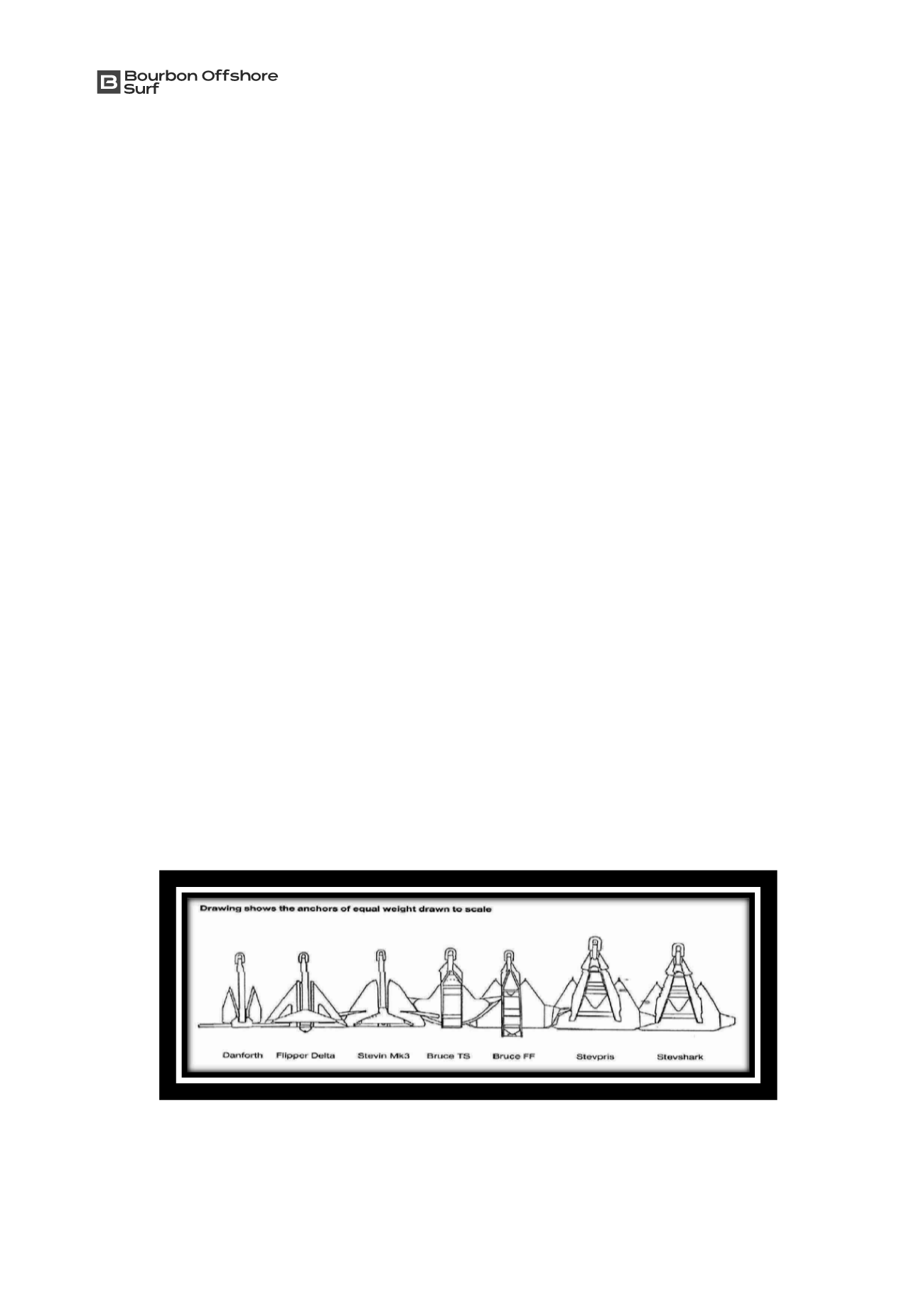
T
he
S
tevpr
i
s
anchor
i
s
a
deep
penetrat
i
ng
anchor
;
such
anchors
offer
h
i
gh
ho
l
d
i
ng
power
. T
he
V
-
shaped
shan
k
of
the
S
tevpr
i
s
anchor
perm
i
ts
the
so
il
to
pass
through
the
shan
k l
egs
. T
he
pennant
eye
or
the
chaser
near
the
anchor
shac
kl
e
forms
a
l
ever
to
turn
out
the
f
l
u
k
e
. T
h
i
s
comb
i
nat
i
on means
that
the
S
tevpr
i
s
anchor
needs
re
l
at
i
ve
l
y
l
ow brea
ki
ng
out
forces
compared
to other
anchor
des
i
gns
.
T
he
types
of
so
il
c
l
ear
l
y
i
nf
l
uence
brea
ki
ng out
forces
,
regard
l
ess
of
the anchor
type
.
x
I
n
sandy
so
il,
the
brea
ki
ng
out
force
i
s
appro
xi
mate
l
y
12 - 17%
of
the
l
oad he
l
d
.
x
I
n
c
l
ay
th
i
s
percentage w
ill
be h
i
gher
(
6
0%).
x
I
n
soft
so
il
s
i
t w
ill
be
even
h
i
gher
.
x
I
n
st
i
c
k
y so
il
s
i
t
can
e
x
ceed
100%.
T
hese appro
xi
mat
i
ons
are
app
li
cab
l
e
to any anchor
type:
W
hen brea
ki
ng out deep
l
y penetrated anchors
,
the
fo
ll
ow
i
ng
should
be
ta
k
en
i
nto
cons
i
derat
i
on:
T
here
i
s
a
poss
i
b
ili
ty
of
damag
i
ng
the
PCP
system
or
the
wor
k
w
i
re
i
f
the
w
i
re
i
s
over
l
oaded
wh
il
st brea
ki
ng
the
anchor
l
oose
from
the bottom
.
Vers
i
on
SF(BOS-
P
RD-0701.000
5
-
ver
.
C
R). O
r
i
g
i
na
l D
ate:
3
1/12/201
5
.
Vers
i
on
D
ate:
N/
A
.
Va
li
d
vers
i
on
on
l
y on QM
S
s
i
te
.
Page
24
of
60
Procedure prepared by:
BOS
Head
of
O
perat
i
ons
.
Approved
by:
BOS
Head
of
O
perat
i
ons
.
Va
li
dated by:
BOS
Qua
li
ty
R
epresentat
i
ve
.
600