


 627/ Anchor Handling and Towing Operations Procedure / 992

A
nc
h
or
H
andlin
g
and To
w
in
g
O
p
erations
P
rocedure
BOS-
P
RD-2
6
.900
6
14
D
o
not
l
et
the w
i
re
l
ead
from
the
drum
at
l
ess
than
4
turns
from
the
chee
k
s
,
as
the
tens
i
on may
push
the
chee
k
s
out
,
crac
ki
ng we
l
ds
.
D
ur
i
ng
tandem
and
j
o
i
nt
tow
i
ng
operat
i
ons
the
tow
i
ng
gear
shall
be
connected
i
n
tow
i
ng
hoo
k
s
w
i
th
emergency
re
l
ease
or
i
n
some
other way
be
arranged
so
that
i
n
case
of
brea
k
age
i
n
tow
i
ng
li
ne
or
l
oss
of
power/bo
ll
ard
pu
ll i
n
one
of
the
vesse
l
s
,
the
other may be
q
u
i
c
kl
y d
i
sconnected
.
Ri
g
tow
i
ng
gear
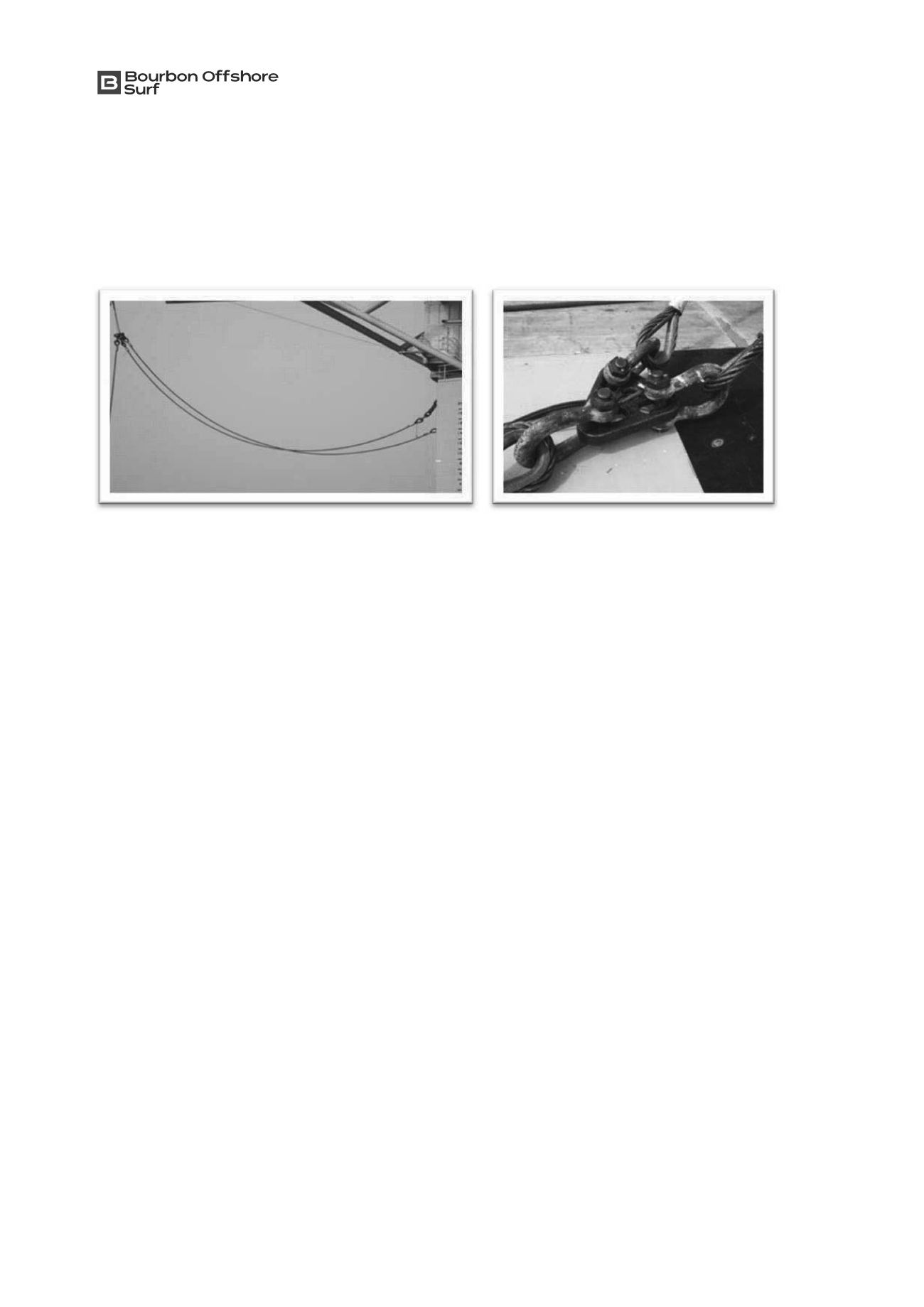
T
ow
i
ng
br
i
d
l
e
4
.
3
.
4
To
w
in
g
s
p
rin
g/
stretc
h
er
T
he most
common
tow
i
ng
spr
i
ngs
are
the e
i
ght
-
strand
bra
i
ded
or
bra
i
d
-
on
-
bra
i
d mode
l
s
.
I
nspect
i
on procedure:
x
T
he
fu
ll l
ength
of
the
tow
i
ng
spr
i
ng
should
be
e
x
am
i
ned
to
detect
v
i
s
i
b
l
e
n
i
c
k
s
or
abras
i
on
that
cou
l
d
resu
l
t
i
n
strand deter
i
orat
i
on
.
x
T
he
amount
of
wear
and
thus
the
strength
of
the
tow
i
ng
spr
i
ng
can
be
eva
l
uated
by
count
i
ng
the
number
of
damaged
or
bro
k
en
strands
and
by
compar
i
ng
the
i
r
th
i
c
k
ness w
i
th
undamaged
sect
i
ons
of
the
shoc
k li
ne
.
x
Comp
l
ete
sect
i
on
of
the
outer
sheath
of
a
bra
i
d
-
on
-
bra
i
d
tow
i
ng
spr
i
ng
resu
l
ts
i
n
a
theoret
i
ca
l
5
0%
l
oss
of
brea
ki
ng
strength
.
x
A
f
i
d
should
be
used
to
spread
open
and
i
nspect
the
strands
of
e
i
ght or
three
-
strand
tow
i
ng
spr
i
ngs
. T
he ma
i
n
s
i
gns
of wear
are
the
presence
of
powdery
depos
i
ts
due
to
the
fr
i
ct
i
on
between
strands
and
l
ooseness
resu
l
t
i
ng
from
the
l
oss
of
e
l
ast
i
c
reco
il
dur
i
ng
cyc
li
c
l
oad
i
ng
.
x
D
ynam
i
c
forces
generate
fr
i
ct
i
on
between
strands
i
ns
i
de
the
tow
i
ng
spr
i
ng
. T
emperatures
i
ns
i
de
the
tow
i
ng
spr
i
ng
can
be
hot
enough
to
cause
i
nterna
l
fus
i
on
damage
resu
l
t
i
ng
i
n
ser
i
ous
strand
deter
i
orat
i
on
and
s
i
gn
i
f
i
cant
l
oss
of
brea
ki
ng
strength
.
x
T
he
presence
of
stretchmar
k
s
i
nd
i
cate
that
the
tow
i
ng
spr
i
ng
has
been
over
l
oaded
resu
l
t
i
ng
i
n
harden
i
ng of
the
f
i
bers
and
a
l
oss
of
brea
ki
ng
strength
.
x
T
ow
i
ng
spr
i
ng
damage
due
to
chem
i
ca
l
e
x
posure
can
be
detected
i
n
the
form
of
v
i
s
i
b
l
e
f
i
ber
deformat
i
on
or eas
il
y detachab
l
e
strands
.
x
S
un
e
x
posure
can
change
the
dynam
i
c
character
i
st
i
cs
of
a
tow
i
ng
spr
i
ng
. O
ne
i
nd
i
cat
i
on
of
such
damage
i
s
the appearance
of
a
sh
i
ny outer
coat
.
Vers
i
on
S
F(
BOS-
P
RD-0
7
01.000
5
-
ver
.
C
R
)
. O
r
i
g
i
na
l D
ate:
3
1
/
12
/
201
5
.
Vers
i
on
D
ate:
N
/A
.
Va
li
d
vers
i
on
on
l
y on QM
S
s
i
te
.
Page
51
of
60
Procedure prepared by:
BOS
Head
of
O
perat
i
ons
.
Approved
by:
BOS
Head
of
O
perat
i
ons
.
Va
li
dated by:
BOS
Qua
li
ty
R
epresentat
i
ve
.
627