



 187 / 364

Social, societal and environmental responsibility
5.2 Information concerning Danone's social, societal and environmental performance in compliance with the Grenelle II law
DANONE
REGISTRATION DOCUMENT 2015
187
The quantity of raw materials consumed per ton of finished prod-
uct is one of the main criteria for production performance, as raw
materials represent a large portion of the cost structure of Danone
products. Numerous measures are therefore taken to use them
more efficiently:
•
liquid milk, sugar, fruit: in the Fresh Dairy Products Division,
raw material losses are monitored daily at the industrial sites,
and the results are consolidated monthly at the subsidiaries and
Division level for comparison with the monthly loss reduction
goals set during the budget process. The principal actions taken
to reduce these losses include (i) optimizing rawmaterials inven-
tories, and (ii) optimizing production scheduling or production
line scaling to reduce raw materials losses at the start and end
of production runs;
•
packagingmaterials: Danone's packaging development complies
with the ecodesign principles defined in guidelines that were
updated in 2014. These packaging ecodesign guidelines were
rolled out to all Divisions in 2015.
Energy consumption, measures taken to improve
energy efficiency and the use of renewable
energies
Energy consumption
Danone's energy consumption intensity decreased by 5.0% in 2015
relative to 2014, mainly as a result of 4.7% productivity on a like-
for-like basis.
This performance resulted from the application of energy man-
agement best practices at all the Divisions and from transfers of
production to more energy-efficient facilities.
Energy consumption by Danone's production sites
Year ended December 31
(in MWh except intensity in KWh/ton of product)
2014
2015
Thermal energy
(a)
2,819,112
2,825,972
Electricity
(a)
1,962,911
2,011,464
Total
4,782,023
4,837,437
Energy consumption intensity
149.3
141.9
(a) Production Site Environment Scope (see Methodology Note).
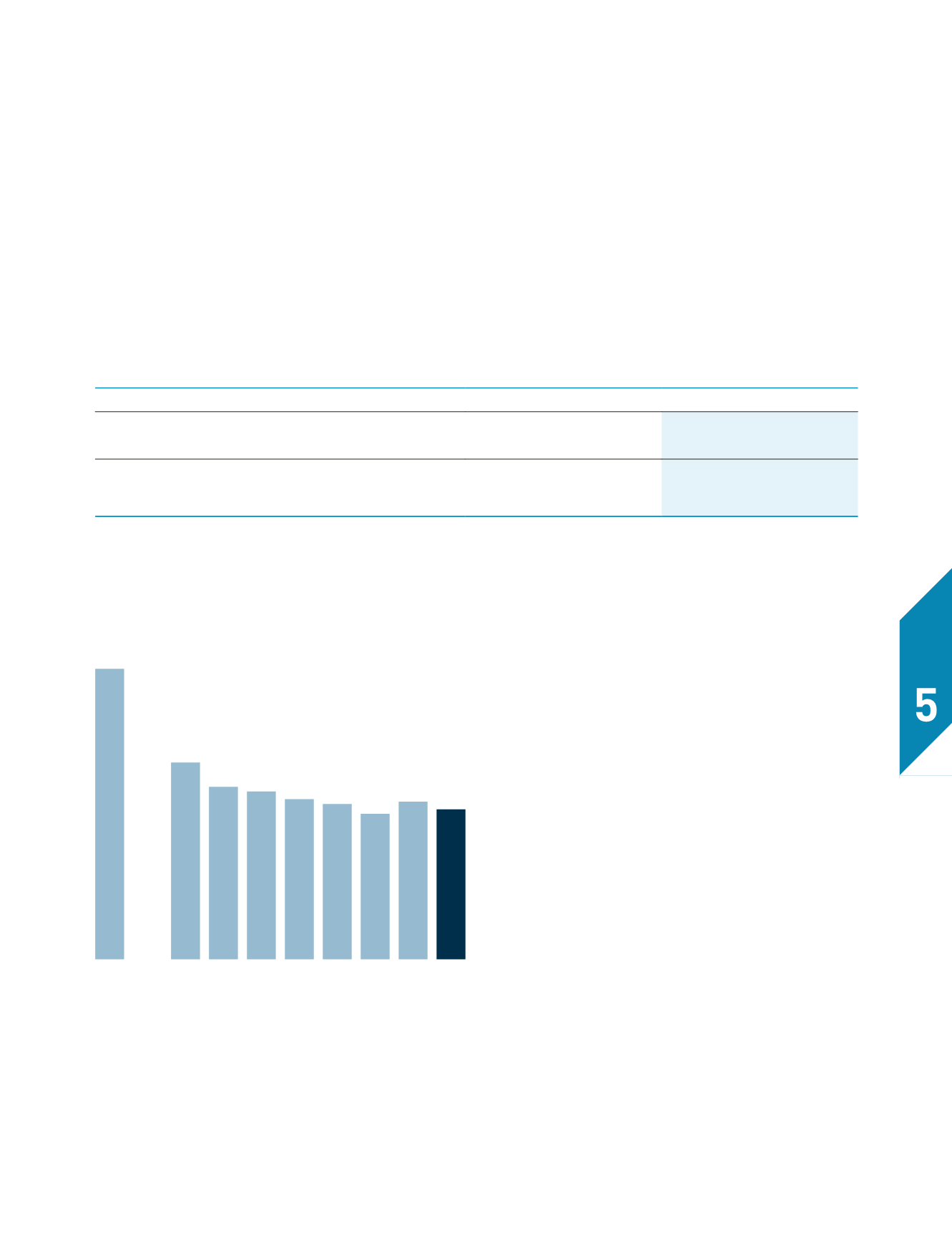
The graph hereafter shows changes in energy consumption intensity
in the production sites since 2000, for the reporting scope of each
of the years concerned.
Total energy consumption intensity in the plants
(in KWh/ton of product)
275.0
186.2
163.3 158.9
151.6 147.1
137.7
149.3
141.9
2000
2008 2009 2010 2011 2012 2013 2014 2015
Measures taken to improve energy efficiency
Danone achieved better energy management through two main
approaches:
•
optimizing energy production at the plants. For example, three
sites in the Fresh Dairy Products Division have installed co-
generation facilities to produce electricity and heating from
a single energy source, thereby improving the plant's energy
performance. Up to 90% of energy can be recovered through
cogeneration, compared to 40% to 55% for traditional systems;
•
optimizing energy use.
Sharing best practices and fostering emulation between Danone's
plants helped to strengthen this improvement process in 2015:
•
in the Waters Division, the “WattWatcher” tool, deployed at all the
sites, allows to set performance objectives tailored to each plant;
•
in the Fresh Dairy Products Division, energy training courses
known as “Energy Campus” continue to bring in energy experts
to implement best practices at all production sites;
•
in the Early Life Nutrition Division, monthly Energy network
actions are implemented.
Use of renewable energies
Thermal energy from renewable sources
Danone is testing renewable energy production and usage projects
at the local level, for instance:
•
in Uruguay, 78% of the thermal energy of the Waters Division's
Minas plant is generated from locally produced biomass energy;
•
in Brazil, at the Poços de Caldas plant in the Fresh Dairy Products
Division, a biomass boiler was installed in August 2011 to replace
the heavy fuel oil used for heating. Thanks to the use of biomass,
nearly all the thermal energy used by the plant is generated from
renewable sources (98%);
•
since 2012, the Early Life Nutrition Division's site in Wexford,
Ireland has used a wood furnace that replaced heavy fossil
fuels and helped to lower the site's fossil fuel energy bill and
greenhouse gas emissions. The energy produced represents
66% of the thermal energy used at the site;